
By Ilan A. Nieuchowicz, Esq. · Florida and District of Columbia attorney · Published and reviewed September 1, 2026 · 9-minute read
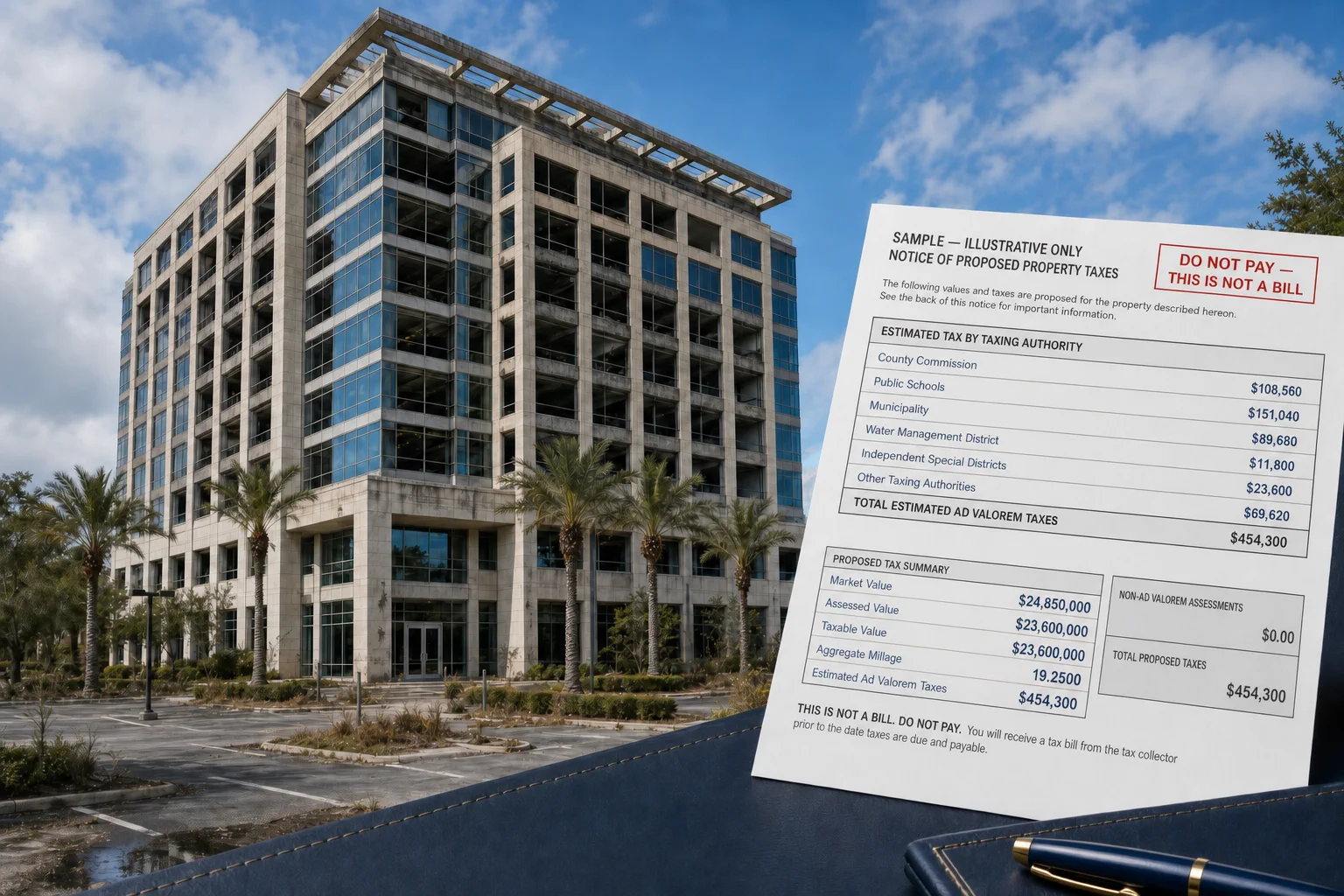
A Florida TRIM notice is not a tax bill. It is the annual notice showing the Property Appraiser's estimate of market value, assessed value, taxable value, exemptions, proposed millage rates, and non-ad valorem assessments.
If something appears wrong, the owner usually has only a short time to act. The first question is the filing deadline. The second is whether correcting the issue would actually reduce taxable value and produce meaningful savings.
Start with the deadline. An informal discussion with the Property Appraiser does not extend the deadline for filing a Value Adjustment Board petition.
Use this sequence:
- Confirm the applicable filing deadline.
- Identify what is being challenged.
- Compare market, assessed, and taxable values.
- Estimate the possible tax effect.
- Gather evidence tied to the January 1 valuation date.
- Choose between informal correction, a VAB petition, or court review.
1. Confirm the Deadline First
For a challenge to value, section 194.011(3)(d), Florida Statutes, generally requires the petition to be filed with the county Value Adjustment Board, or VAB, clerk on or before the 25th day after the Property Appraiser mails the TRIM notice.
A petition involving the denial of an exemption, agricultural classification, or certain other applications generally must be filed on or before the 30th day after the denial notice is mailed. Portability, deferral, classification, and other disputes may follow different triggering notices or procedures. The actual notice and current county instructions control the practical filing process.
Late petitions may be considered upon a sufficient showing of good cause, but relief is discretionary and should not be assumed. A pending records request, appraisal, or informal conference does not preserve the filing deadline.
Selected 2026 valuation-petition deadlines
These dates were recorded from official county VAB pages or filing portals during preparation of this article. Confirm the deadline shown on the property's notice and the current county website before relying on this chart.
| County | Published 2026 deadline | Official filing information |
|---|---|---|
| Broward | September 18, 2026 | Broward County VAB |
| Miami-Dade | September 18, 2026 | Miami-Dade filing portal |
| Palm Beach | September 14, 2026 | Palm Beach County VAB |
| Martin | September 8, 2026 | Martin County filing portal |
| St. Lucie | September 8, 2026 | St. Lucie County VAB |
| Orange | September 18, 2026 | Orange County VAB FAQ |
| Polk | September 11, 2026, at 5:00 p.m. | Polk County filing portal |
Do not borrow another county's deadline. Mailing dates, filing methods, fees, and cut-off times vary. Different deadlines may apply to exemption, classification, agricultural, portability, deferral, and other disputes.
2. Identify What Is Actually Wrong
A TRIM notice contains several numbers and several possible issues. Separating them prevents an owner from challenging the wrong item.
- Market or just value: the Property Appraiser's estimate of value as of January 1.
- Assessed value: market value after any applicable assessment limitation.
- Taxable value: assessed value after applicable exemptions.
- Millage rate: the tax rate imposed by the applicable taxing authorities.
- Non-ad valorem assessments: charges for services such as solid waste, drainage, lighting, or fire services that generally are not based on property value.
A VAB petition may concern value, an exemption, classification, portability, or an assessment limitation. Objections to proposed millage rates or governmental budgets generally belong at the taxing authority's public budget hearing, not in a valuation petition. Non-ad valorem assessments ordinarily require a separate analysis.
Will a market-value reduction lower taxable value?
Not always. If assessed value is already well below market value because of an assessment cap, reducing market value may produce little or no immediate tax savings.
- Homestead property generally receives the Save Our Homes limitation.
- Qualifying non-homestead property generally receives a 10% limitation for non-school levies under section 193.1555, Florida Statutes.
- A change of ownership or control, qualifying improvement, or other statutory event may reset or alter an assessment limitation.
Before paying for an appraisal or preparing a detailed case, compare the current market value, school and non-school assessed values, exemptions, taxable values, and prior-year figures. If assessed value is equal or close to market value, a supportable value reduction is more likely to reach taxable value.
3. Estimate the Possible Savings
For a preliminary screen, use the aggregate millage rate shown on the TRIM notice:
Reduction in taxable value × aggregate millage rate ÷ 1,000 = estimated annual ad valorem tax savings
For example, at an illustrative aggregate rate of 20 mills:
| Reduction in taxable value | Estimated annual savings |
|---|---|
| $100,000 | $2,000 |
| $250,000 | $5,000 |
| $500,000 | $10,000 |
These figures are illustrations, not predictions. Actual savings depend on the parcel's location, school and non-school assessed values, exemptions, assessment limitations, final millage rates, and whether the proposed reduction reaches taxable value. Non-ad valorem assessments generally remain unchanged.
The economic decision should also account for the strength of the evidence, the likely cost of appraisal or expert work, the possibility of only partial success, and the expected holding period. Future savings should not be assumed; later assessments remain subject to market values, caps, ownership changes, improvements, and other statutory rules.
4. Gather Evidence That Addresses January 1
Florida property is generally valued as of January 1 of the tax year. The most useful evidence explains the property's condition, use, restrictions, and economics on that date.
Begin with the TRIM notice and property record card. Check for errors in ownership, parcel characteristics, square footage, construction, condition, use, classification, exemptions, and assessment limitations.
Depending on the property and issue, useful evidence may include:
- deeds, closing statements, surveys, plans, and square-footage records;
- photographs, inspection reports, repair estimates, and deferred-maintenance records;
- zoning, access, density, development, permitting, or environmental restrictions;
- comparable sales with appropriate adjustments;
- rent rolls, leases, vacancy, concessions, and collection loss;
- historical operating statements and normalized expenses;
- capitalization-rate or discount-rate support; and
- existing appraisals and correspondence with the Property Appraiser.
Commercial and income-producing property often requires more than nearby sales. The analysis may need to address actual income, expenses, occupancy, lease terms, tenant improvements, leasing commissions, physical condition, and whether the mass-appraisal assumptions fit the property.
A Florida-certified appraiser is generally the appropriate professional for a formal valuation opinion or expert testimony. A commercial broker may provide market and leasing evidence. Counsel can evaluate procedure, legal issues, ownership or control questions, evidence strategy, and litigation risk.
5. Choose the Appropriate Route
Informal correction
Start with the Property Appraiser when the issue appears to be a clear record, square-footage, ownership, exemption, classification, cap, or data-entry error. Informal review may resolve the problem efficiently, but it does not extend the VAB deadline.
Value Adjustment Board petition
A VAB petition may be appropriate when the evidence supports a meaningful correction and informal review is unavailable, unsuccessful, or cannot be completed before the deadline. The petition must comply with the county's filing method, form, fee, and deadline.
Under section 194.011, the petitioner and Property Appraiser generally must exchange evidence lists, supporting documents, and witness summaries at least 15 days before the hearing. The party initiating the challenge bears the burden of proof. Under section 194.301, Florida Statutes, the assessment may receive a presumption of correctness if the Property Appraiser establishes compliance with professional appraisal standards and the statutory criteria.
Filing a petition does not eliminate applicable tax-payment requirements. Review the current county instructions and section 194.014, Florida Statutes.
Circuit-court review
A taxpayer may challenge an assessment directly in circuit court or pursue court relief after the VAB process. The required parties, payment requirements, and deadline depend on the dispute and procedural posture. Section 194.171, Florida Statutes, generally provides a 60-day limitations period measured as specified in the statute. Its timing and payment requirements are jurisdictional, so owners considering litigation should obtain advice promptly.
6. A Simple Decision Checklist
- I confirmed the deadline on the notice and county VAB website.
- I identified whether the issue concerns value, classification, exemption, portability, or an assessment limitation.
- I determined whether a correction would reduce taxable value.
- I estimated the savings using the parcel's actual millage rate.
- I gathered evidence tied to the January 1 valuation date.
- I selected the informal, VAB, or court route before the applicable deadline.
Discuss a Potential Assessment Challenge
Nieuchowicz Law evaluates property-tax disputes involving valuation, procedure, ownership, assessment limitations, and related real-estate issues. Ilan A. Nieuchowicz is a Florida real estate attorney and litigator and a Florida-licensed real estate broker. When a certified appraisal or appraisal testimony is needed, the firm can coordinate with an appropriately licensed appraiser.
Contact the firm to discuss whether a focused assessment review is appropriate. Any scope and fee will be confirmed after conflicts review and evaluation of the property, available evidence, and applicable deadline.
Request a consultationOfficial resources
Current law and filing procedures should be checked at the time of action. Start with the Florida Department of Revenue's VAB resources, section 194.011, Florida Statutes, the property's actual notice, and the applicable county VAB clerk.
This article provides general information and is not legal, tax, brokerage, or appraisal advice. Reading this article or submitting an inquiry does not create an attorney-client relationship. Every property and assessment must be evaluated individually. Government websites and statutes may be updated, and the applicable county notice and current law control. Prior outcomes do not guarantee a similar result.